– By Bianca Bruder, MagsBC intern, November 2025
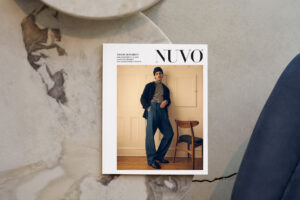
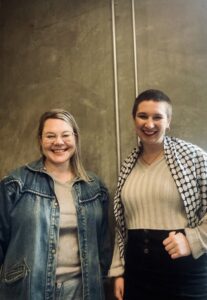
Emily and Katherine met in November 2024 at an event hosted by The Capilano Review, the No Arms in the Arts Festival, and only five months later, Emily joined their editing team.
Emily is a poet (she published a book of poems, All Still, in 2008) and interdisciplinary scholar at Simon Fraser University. She grew up on the unceded and unsurrendered territories of the Halkomelem-speaking peoples in the extra colonial suburb we call New Westminster, attended SFU, and completed a PhD in cultural studies at the University of Minnesota in 2019. Most recently, she has become a literacy teacher at several colleges. Currently, Emily is writing two new manuscripts on poetry and arts. Since April 2025, she has been the literary editor at The Capilano Review.
Katherine holds a Master of Arts in English literature, women and gender studies from the University of Toronto, where her research focused on contemporary Canadian literature, with particular attention to literary magazines, small presses, and zines. She has been a frequent contributor to Discorder Magazine, is a reader with The Ex-Puritan, and is on the board of Briarpatch Magazine. She has been the managing editor at The Capilano Review since April 2024.
I interviewed both of them to find out about their different approaches leading them to careers into editing literary works, why they enjoy working together, and how they think community and passion are key elements in facing their future at a small magazine.
B: I’m curious about your first steps in literature. How did you get involved with this?
K: I connected with the local writing and arts community when doing my undergraduate degree at UBC, where I got involved with the campus and community radio station and magazine. Through that, I had the opportunity to learn about unique and thoughtful projects artists and writers in our community were working on, and see excitement and support grow around their work. It shaped my academic interests, and my master’s degree focused on the role of independent magazines, small presses, and zines in building alternative communities.
E: Reading and writing were a huge part of my childhood but my first career goals were actually in dance–I wanted to be a choreographer. That changed, when I took classes in creative writing at SFU. I developed friendships with writers and artists who continue to be collaborators today. Actually, I was aiming for an academic career, because at that time I thought it would offer me stability and help me to gain confidence in finding my own creative voice. Over the past few years, it’s been my students who have helped me keep an open heart and a passion for literature, and I’m really fortunate to continue that work while learning to be an editor, too. The jobs are much more alike than one might anticipate!
B: That sounds great. Tell me more about your work at The Capilano Review. Teamwork is considered to be a valuable asset there. Why do you feel so strongly about this?
K & E: We are a small team of three part-time editors, one of us being Jacquelyn Zong-Li Ross, our art director, who is currently on maternity leave (but whose talents inspire us even in her absence)!
At The Capilano Review, we have a collaborative, non-hierarchical staff structure. Each role is so deeply connected to the others, and our work is stronger when we are communicating regularly. It is always an asset to have multiple brains and perspectives at the table.
That’s why we work together closely and are deeply familiar with the timelines and rhythms of each other’s work. We collaborate on grant writing, special projects, events and workshops, and many of the daily aspects of our work.
There are times when some of us have heavier workloads than others, and we are more equipped to support each other and relieve the load when we are already familiar with each other’s work and ongoing projects. Our publication is committed to collaboration, community building, and creating space for thoughtful, intentional work, and we work hard to ensure our workplace aligns with the organization’s values.
B: What part about editing do you enjoy the most and why?
K: It’s impossible to choose just one! Speaking broadly, I love being so connected to a community of writers and artists whose work I admire and who shape my own thinking and work. It’s a privilege to spend every day supporting a magazine whose vision I passionately believe in, which is publishing content that speaks to the current moment uniquely and creatively. The publication feels like a breath of fresh air and an invitation to think and feel deeply. I feel honoured that each artist and writer we publish trusts us with their work.
To give a more specific answer, my favourite work day(s) each year are when I get to sit down with a draft of the new issue and read it cover to cover, feeling the rhythm of the works, their sequencing, and how everything ties together. The art and literary editors always do a fantastic job of assembling an issue, and it’s a delight to see what they produce.
I also enjoy spreadsheets, budgets, and grants, because there is something calming about formulas, but that’s a lot less exciting to talk about.
E: There is so much that I love about my job, but my favourite aspect so far has been the editorial team! I learn from each of them constantly and have immense gratitude for the work that they put into the publication and the ways they show up in the world–now and over past few years, at the magazine and more broadly. I feel lucky to collaborate with them and, of course, to meet the constellations of writers and artists in our orbit.
I also really value the time that the position opens up, which encourages me to be attentive to texts in new ways, as methodical as I truly love to be, and intentional in seeking new connections. This feels like a rarity in paid and unpaid labour alike!
B: Is there also something you find challenging about your job as an editor right now?
K & E: It is widely known that the arts industry and the publishing industry are struggling. Rising production costs, austerity budgets, and limited public funding make it difficult to continue doing the work we love. However, we maintain energy by focusing on the value of our publication and the unique role it serves in the local and national publishing industry; as long as there is a keen audience for we will find a way to produce it.
B: What do you think the future will hold for both the local and Canadian magazine industry?
K & E: There is a lot of pessimism there, and understandably so. However, as we are increasingly inundated with avalanches of content and urges to digitize our lives, there is value in engaging with something slower and more physical that does not demand our attention, but instead invites careful thinking and tender feeling.
B: Do you have any advice to people who want to build up a career in editing?
K & E: In the words of RuPaul’s Drag Race and the children’s literacy organization Reading Is Fundamental (or to name a Canadian one, The Writers‘ Exchange), our own childhood pastime lays the foundation for so many of our shared skills in editing, writing, or teaching. Even if relationships to reading change over time, or if you are coming to love literature as an adult, the page in front of you is the best place to start.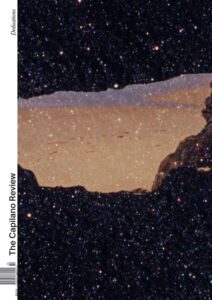
B: Your favourite quote?
K: This is from a poem by Brandi Bird, published in their collection The All + Flesh, entitled “Ars Poetica, Or Ocean Vuong Wrote Loneliness is Still Time Spent With the World.” The lines that have kept me company this past year are: “I know / then that there is hope / until I die & then / there is other / people’s / hope.”
E: “Kim, you’re doing amazing sweetie.” (The Kardashians)
An editor would add: [sic].
Find The Capilano Review on Instagram, X, Facebook and their website.